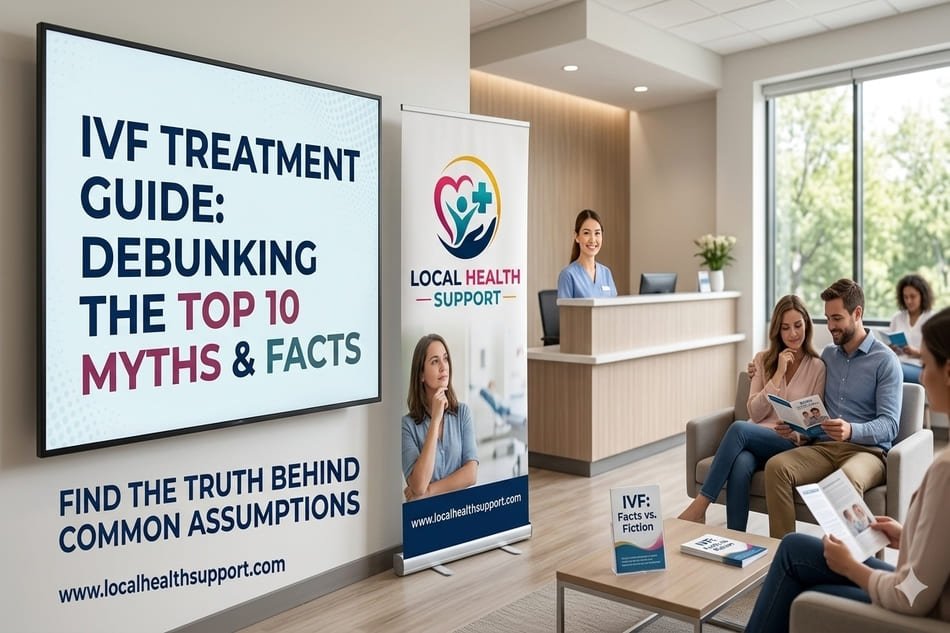
IVF Treatment Guide: Debunking the Top 10 Myths and Facts
Top 10 IVF Myths and Facts – For many couples, the process of infertility is a very difficult one that can be challenging both emotionally and physically. In Vitro Fertilisation (IVF) is a ray of hope when natural conception is not possible. This medical miracle has resulted in millions of healthy babies being born around the world.
But even though it’s a worldwide success, there is a lot of misinformation about IVF. There are many misconceptions and taboos that can hinder couples from getting prompt assistance.
We are debunking the top IVF myths and facts according to medical science so you can make informed decisions on your fertility journey.
What is IVF?
So before you get bogged down in the myths let’s first define what IVF is. Assisted reproductive technology (ART) in which an egg is fertilized in a laboratory by sperm outside the body is called In Vitro Fertilization. The embryo is then delicately reinserted into the woman’s uterus for implantation.
Let’s Debunk Some of the Top 10 IVF Myths and Facts
1. The first myth is that IVF is 100% successful the first time.
The Fact: IVF is very successful, but it does not promise 100% success on the first IVF cycle. IVF success is largely dependent on a number of factors, such as the woman’s age, underlying cause of her infertility and the quality of her eggs/sperm. For women under 35, success rates are typically at about 40-50% per cycle and can take multiple cycles to get a successful pregnancy.
Myth 2: IVF babies have birth defects or are “unnatural.
The Fact: IVF babies are normal and healthy. There is really no difference between a natural conception and an IVF conception except that the place in which the fertilization takes place is different – in a lab dish versus the fallopian tube. Once the embryo is implanted in the womb, the pregnancy progresses just like any other. There are no reliable scientific differences in the development, intelligence or life-long health of IVF babies and naturally conceived babies, according to a number of studies around the world.
Myth 3: IVF always leads to twins, triplets or multiple births.
The Truth: With IVF, there’s a slightly increased risk of multiple pregnancies but it’s not required. Twins and triplets were common in the past with doctors transferring more embryos into the uterus to boost success rates. But these days, most fertility clinics opt for Single Embryo Transfer (eSET), which means the mother and child have a safer and healthier pregnancy.
Myth 4: It’s essential to lay absolutely still for 9 months following IVF.
The fact is one of the largest misunderstandings. The 9 months bed rest is not required. A day or two rest following the embryo transfer procedure is recommended. After which, women are asked to get back to their normal lifestyle. Light movement and walking helps to improve blood flow, which is actually beneficial to implantation, in fact.
Myth 5: IVF is only a treatment for women who are infertile.
The FACT: Fertility is a partnership. Healthcare data shows that approximately one-third of cases of infertility are caused by women’s factors, one-third by men’s factors (such as low sperm count or motility), and the rest by a mix of male and female factors or other unexplained reasons. In high cases of male infertility, IVF, a more sophisticated procedure known as ICSI (Intracytoplasmic Sperm Injection), is a great choice.
Myth 6: IVF is overly invasive, and patients spend too much time in hospitals.
The Fact: IVF requires injections and a few minor medical procedures, but is primarily painless and outpatient. Hormone injections are administered with very small needles (like those used for insulin) that are very comfortable. The egg retrieval is done while you are lightly anaesthetised, so you won’t feel any pain whilst the procedure is being done and you will most likely be able to go home on the same day.
Myth 7: IVF is just for older couples.
The Fact: Age plays an important factor in fertility, but IVF is not limited to older people. For younger couples who are dealing with certain problems, such as blocked fallopian tubes, severe endometriosis, genetic defects and severe male factor infertility, IVF is often the answer to a successful pregnancy outcome.
Myth 8: IVF medicines and injections contribute to cancer later in life.
The Fact: A variety of long term scientific studies have shown no direct connection between IVF fertility drugs and an increased risk of breast cancer or ovarian cancer. The hormones given are meant to stimulate eggs to be produced for a short time in the course of the treatment, but are quickly flushed out of the body.
Myth 9: When you choose to undergo IVF, you will certainly need to have a C-section (Cesarean) delivery.
The Fact: IVF pregnancy doesn’t necessarily require a C-Section delivery. It will rely on the normal obstetric variables that are near the due date, including the position of the baby, the mother’s health status and the progress of labor. Most women who become pregnant with IVF have normal vaginal births.
Myth 10: IVF has a depleting effect on all a woman’s eggs and causes menopause.
The Fact: A girl has a million eggs when she is born. A pool of eggs starts maturing each month but, of course, only the dominant one emerges and the other eggs disintegrate. IVF medications are just able to harvest and mature those eggs that would have naturally perished during that cycle anyway. Does not deplete your total egg supply and does not lead to early menopause.
Conclusion
IVF is a safe medical development scientifically proven and has helped millions of couples to welcome parenthood. End the myths and societal fear and start your family. If you don’t become pregnant naturally for over a year, talk to a trusted fertility specialist about your options.
For more reliable guidance, medical insights, and wellness tips, turn to Local Health Support. As a dedicated healthcare platform, Local Health Support is committed to bringing you accurate, expert-backed health information so you can confidently navigate every step of your medical journey.
Disclaimer: Please note that this blog post may not reflect professional medical advice and is for information and education only. Please see a qualified health care provider or reproductive endocrinologist for any medical condition or treatment regimen.
People Also Ask
Q1: What are the chances of the first IVF cycle?
Ans: While some patients get pregnant on their first attempt, many require two or three cycles to achieve a successful pregnancy. Very individualistic success rates with particular emphasis on maternal age.
Q2: Does the IVF egg retrieval process hurt?
Ans: The egg retrieval is done under conscious sedation or light anaesthesia. This will cause you to fall asleep during this short 15-20 minute procedure, and you will not feel any pain. There may be some cramping or spotting afterwards that subsides rapidly.
Q3: What is the ideal age to undergo IVF treatment?
Ans: IVF success rates are highest in the 20s and early 30s in women primarily because of their high quality eggs. Women in their late 30s and 40s also become pregnant successfully using IVF sometimes using donor eggs as recommended by their specialist.
Q4: What can I do after an embryo transfer?
Ans: Yes. Usually, the day following the transfer, it is possible to switch to a desk job and light everyday activities. But doctors don’t recommend large amounts of weight, strenuous exercise and excessive travel before the two-week period before a pregnancy test.